- Welcome Guest
- Sign In
- Welcome Guest
- Sign In

Google Earth turned its gaze upward Wednesday with the debut of a new feature that allows users to view the best images of the sky captured by astronomers around the globe. Called "Sky," the new feature lets Google Earth users view and navigate through 200 million galaxies. The images presented are ...

The face of the Internet is rapidly changing. For instance, Web maps are no longer about finding your house online. A few years ago, map-making power remained in the hands of specialists. Today, map-making power is within everyone's grasp. In the past two years, Web giants like Google, Microsoft and...

Clunky old batteries may soon be a thing of the past thanks to a new energy-storage device that looks and feels like a scrap of paper. Developed by a team of researchers at Rensselaer Polytechnic Institute, the nanoengineered battery is 90 percent cellulose, made up of the same plant cells used in n...

President Bush signed into law Thursday the America Competes Act, designed to boost research and education in math and the sciences through a funding package of about $42 billion. The bill aims to bolster basic research in the physical sciences, to improve instruction in math at the elementary and m...

Using the latest advances in genetics, two biofuel companies have developed a way to turn plant matter into fuel that can meet the nation's energy needs. In a process similar to brewing beer, the firms use genetically engineered microbes to turn a broth of plant material, water and sugar into a biof...

Boldly claiming "the future of PC navigation starts now," peripheral vendor Logitech has unveiled a laser mouse that uses motion-control and wireless technology so users can click, scroll and perform other control functions while holding the unit in the air from across a room. The new Logitech MX Ai...
An Irish technology development company Steorn claims it can produce free, clean and constant energy without taking the energy from an external source. In effect, the company claims it has produced an energy-making machine it calls Orbo. Despite apparently violating fundamental laws of physics, Steo...
University of Maryland researcher Uzi Vishkin announced this week that he has created a prototype device using a parallel processor that could very well be the "next generation of personal computers." The test model, using technology based on parallel processing on a single chip, is capable of compu...
Genome researchers have successfully transformed one bacterial species into another by replacing all of its DNA, according to a report published Thursday. Biologists at the J. Craig Venter Institute transplanted the entire genome, or set of DNA, from one species of Mycoplasma bacteria into another.

A team of Israeli researchers have created a new map of the Internet that reveals the worldwide network in more detail than ever before. "The Internet evolves in a distributed manner, and therefore its structure is unknown," Shai Carmi, a physicist at Bar-Ilan University who participated in the rese...

For four years now, IBM's Blue Gene/L has remained king of the hill as far as supercomputers are concerned, according to listings from TOP500 Supercomputer Sites, an organization that ranks the world's most powerful systems. On Wednesday, Blue Gene/L again appeared at the top of the TOP500 list. IBM...

Three new robotic vehicles designed by researchers at Woods Hole Oceanographic Institute will embark on an expedition next month to search for life on the Arctic Ocean floor. The vehicles -- two autonomous underwater vehicles and a tethered, remote controlled sampling system -- were designed specifi...
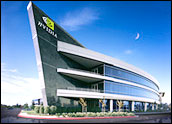
The world of high performance computing is expanding every day, particularly in the fields of geosciences, molecular biology and medical diagnostics, where scientists are increasingly turning to supercomputers to crunch massive amounts of data via complex simulations and applications. Graphics proce...

A promising technology that involves controlling light with magnets could improve the speed and reduce the juice requirements of future computer chips. The technology, developed by researchers at the U.S. Navy Research Laboratory in Washington, D.C., and the University of Alberta in Edmonton, Canada...

A new sensor design introduced Thursday by Kodak will double, and possibly quadruple, the light sensitivity of digital cameras, according to the company. Describing the technology as "groundbreaking," Kodak said the advance in image sensor design will drastically improve the quality of digital pictu...
 Loading ...