- Welcome Guest
- Sign In
- Welcome Guest
- Sign In
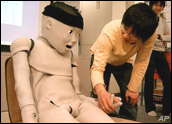
Researchers at Osaka University in Japan demonstrated on Friday a toddler robot designed to assist in studies of child development. Called the "Child-Robot with Biomimetic Body," or CB2, the robot is designed to mimic a real, human child between one and three years old. It stands just over 4 feet ta...

Power cords and chargers may rule the technological world today, but their days could be numbered, thanks to a breakthrough at MIT. It's called "WiTricity," and it's essentially the transfer of power through the air, without wires. It was demonstrated by a team of researchers from MIT's Department o...

At $30 million a ticket for orbital space travel and about $200,000 for suborbital trips, demand can only go so far. Before space tourism can really take off -- so to speak -- prices are going to have to come down, and that may require a new business model. While many early efforts have been single-...
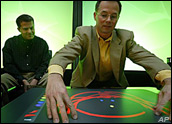
Microsoft has taken the touchscreen PC concept in a new direction, amping it up with a 30-inch screen, giving it five eyes and turning it horizontal to create a coffee table that can sense multiple touches at the same time. Based on Windows Vista and called "Microsoft Surface," the new computer can ...

Sony has developed a display screen so thin it can bend like a piece of paper while at the same time showing full-color video. In the continuing race to shrink the size of gadgets while increasing the amount of cutting-edge technology crammed inside, Sony has topped its competitors with the release ...

Web surfers all too familiar with the distorted-letter tests that accompany so many site registration forms today can now take heart -- the time they spend on those tests is being put to good use. Thanks to a project at Carnegie Mellon University, a new version of those pesky CAPTCHA tests makes the...

Before orbital travel becomes commonplace, there's another type of suborbital transit that will likely help fuel the orbital market while fulfilling a critical need in its own right. It's called "point-to-point transportation," and it would use suborbital travel to deliver cargo or people from one p...
When billionaire Charles Simonyi blasted off into space for a visit to the International Space Station last month, he not only made history as the fifth private citizen to fly into orbit. He also fulfilled what for many is a lifelong dream: To explore the final frontier. The prospect of traveling in...

IBM has developed a method of assembling microchips using nanotechnology, the company stated Thursday, a potentially revolutionary process for insulating tiny wires by allowing them to assemble themselves around air gaps. This advance could make next-generation chips dramatically faster and more ene...
IBM is working to turn its System z mainframe computer into an online 3-D gaming platform, and it's doing it by putting advanced technology used in video games into a mainframe. The idea is to merge the massive transaction and account-based scalability of the mainframe with the graphics power of the...
Intel unveiled its mobile strategy Wednesday at the Intel Developer Forum in Beijing. Personalization and content are key drivers behind the increased demand for notebook PCs and mobile Internet devices, according to Intel executives David Perlmutter and Anand Chandrasekher. "The Internet is one of ...

IBM on Thursday announced a method of connecting processors inside of products ranging from cell phones to PCs to supercomputers. This breakthrough -- dubbed "through-silicon vias" -- allows for a move away from horizontal 2-D chip layouts to 3-D chip stacking, where chips and other components that ...
Silicon is the lifeblood of electronics today, but in the photonics world -- the world of lasers and fiber optic transport -- it has had to play second fiddle to more exotic substances like indium phosphide and gallium arsenide. Researchers, though, are working to change that orchestration and reap ...
Researchers at St. Louis University in Missouri announced the development of a fuel cell battery powered by liquid sugar Sunday at the American Chemistry Society's 233rd national meeting. Using nearly anything from natural substances such as tree sap to man-made beverages including soda, the new tec...
IBM researchers are touting a new tiny optical transceiver chipset that can move data at speeds up to 160 GB per second, which is eight times faster than previous optical components. The new chipset generates fast data transfer rates because it uses light pulses to move data instead of sending elect...
 Loading ...