- Welcome Guest
- Sign In
- Welcome Guest
- Sign In

You may think you know the shortest, quickest route to work, but wait till Google get its hands on your steering wheel. Smart technology may save you gas you didn't even know you were wasting. Ford is working with Google to harness the power of cloud computing and analytics in order to design techn...

The phrase "In the beginning was the Word" may soon take on a whole new meaning for cellphone users, if work being done by a researcher at South Korea's Sungkyunkwan University pans out.The scientist, Sang-Woo Kim, has been working on converting sound into electricity. Among other things, the techno...
Intel has reported a major technological breakthrough in microprocessor development: the world's first 3D transistor. The Tri-Gate transistor will continue the steady delivery of computing products that are ever more powerful, ever cheaper and ever smaller, the company said. What Intel has done is r...

Researchers in Japan are working on a device that has managed to intrigue -- or at least amuse -- public relations executives, social scientists and even the patent holders of a sanitizer for computer keyboards and other peripherals: an Internet-based kissing machine. Yes. A work in progress by Kaji...
The future of mobile healthcare apps is already here, and it readily conjures images of "Star Trek" and Dr. "Bones" McCoy's medical tricorder. Take for example, a new app system developed by researchers at Massachusetts General Hospital that detects cancer. The palm-size nuclear magnetic resonance d...
A team of scientists at the Massachusetts Institute of Technology has developed what it describes as the first practical artificial leaf. The device, made from silicon, electronics and catalysts, is the same size and shape as a playing card, but thinner. It splits water into its two components, hydr...

When so-called "minicomputers" first appeared in the 1970s, they supplanted mainframes on a scale of size and cost expressed by Bell's Law, which holds that a new class of smaller, cheaper computers comes along roughly every 10 years. Personal computers, notebooks, smartphones, and tablets followed,...
Researchers at the University of Illinois claim to have made a breakthrough in phase-change materials technology that could lengthen battery life by up to two orders of magnitude, or 100 times. The team, led by Professor Eric Pop, used carbon nanotube electrodes, it stated in a paper published in Sc...
Aptly named Tobii Technology -- spelled with not one, but two "i's" -- unveiled the world's first eye-controlled laptop at CeBIT Tuesday.Developed with computer manufacturer Lenovo, the laptop uses Tobii's eye-tracking technology to enhance interaction at a glance. Eyeing points on the screen rele...

Lasers amplify light. The name itself is an acronym for "Light Amplification by Stimulated Emission of Radiation." It's only natural then that the world's first anti-laser cancels light, and could spark applications in optical supercomputing and radiation oncology. "Our device is a laser that works ...
Science fiction enthusiasts could probably connect over plans Microsoft announced Monday for Kinect, the company's interactive gaming add-on for the Xbox 360. A software developers kit is on the way, Microsoft representatives told journalists at a sneak-peek event that featured a Kinect digital ren...
Twenty years from now, semiconductor chips will cost a penny apiece and will be in everything -- our clothing, our sunglasses, our contact lenses and even our toilets -- physicist Michio Kaku told an audience Thursday at the RSA 2011 convention. They'll revolutionize warfare, manufacturing and the m...
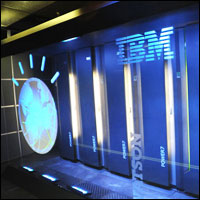
Fresh from a super-sized "Jeopardy" victory where it looked suspiciously like President Obama's ubiquitous teleprompter, IBM supercomputer Watson is about to become Dr. Watson, M.D. assistant. A joint venture will combine IBM's question-answering, language-processing, and machine-learning capabilit...
As IBM celebrates its centennial this year, the company is building technologies to take us into the future. IBM's Watson computer has pounded its human opponents on the game show "Jeopardy," signaling huge improvements in the development of artificial intelligence and cognitive computing. Meanwhile...

Ten-4. Back to you. Over. On a radio or over the TV airwaves, speakers have to rely on back-and-forth communications because radio traffic only flows in one direction at a time on a frequency. Or so said scientific conventional wisdom, until Stanford researchers developed so-called "full duplex" r...
 Loading ...